
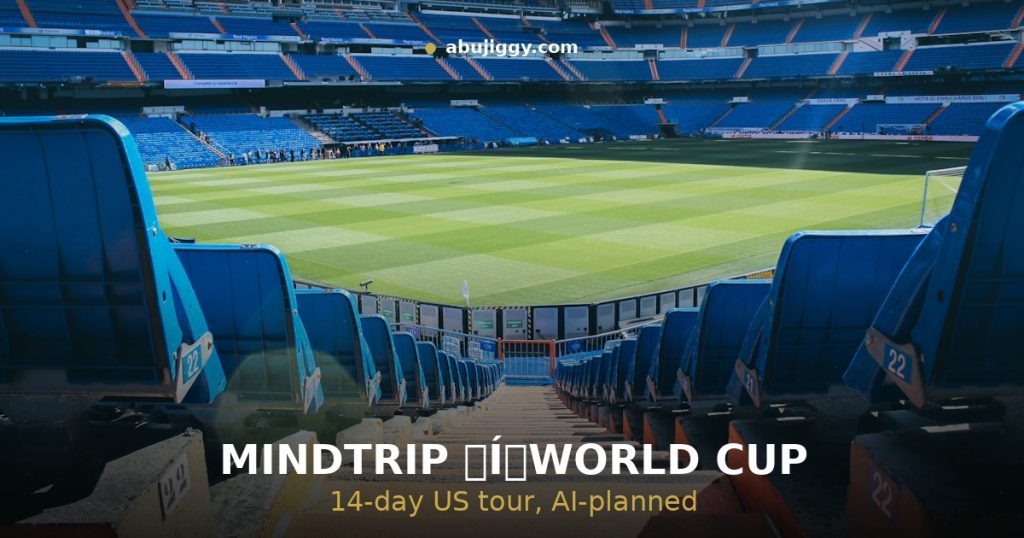
When FIFA announced the 2026 World Cup would sprawl across 16 cities in three countries, I knew traditional trip planning wouldn’t cut it. So I decided to test MindTrip AI with a brutal constraint: plan a 14-day journey from Dubai to catch four group-stage matches across the US East Coast, starting June 12, 2026. What I discovered was both impressive and frustrating — a glimpse of AI travel planning’s future, complete with its current blind spots.
The Challenge: Four Cities, Four Matches, Zero Margin for Error
I fed MindTrip a specific brief: “Plan a 14-day FIFA World Cup 2026 trip from Dubai (DXB) to attend 4 group-stage matches. Route through NYC/MetLife Stadium, Boston/Gillette Stadium, Philadelphia/Lincoln Financial Field, and Atlanta/Mercedes-Benz Stadium. Prioritize match-day logistics and minimize travel stress between cities.”
The AI needed to solve several complex puzzles simultaneously: optimal flight routing from the Middle East, ground transportation between cities that span 1,000+ miles, accommodation near stadiums during peak demand, and day-of-match logistics for venues with notoriously difficult parking situations. This wasn’t a simple beach vacation request.
Within 90 seconds, MindTrip delivered a comprehensive 47-point itinerary that looked professionally crafted. The speed impressed me, but the real test would be in the details.
Flight Routing: MindTrip Nailed the Big Picture, Missed the Fine Print
The AI suggested a sensible routing structure: Emirates DXB→JFK direct (14 hours), then domestic hops between East Coast cities, finishing with a Delta ATL→DXB connection through Amsterdam. Total flight budget estimate: USD 2,400-2,800 (AED 8,800-10,300).
MindTrip correctly identified that starting in New York made geographic sense for an East Coast loop, and it smartly suggested booking the transatlantic legs first while leaving domestic segments flexible. It even flagged that June is peak summer travel season, recommending booking 4-5 months ahead.
However, the AI completely whiffed on visa processing times. It casually mentioned “ensure ESTA is valid” without acknowledging that UAE passport holders need B1/B2 tourist visas — a process that currently takes 8-12 weeks for interview scheduling at the Dubai consulate. This oversight could have derailed the entire trip for someone following the plan blindly.
Inter-City Transportation: Where AI Logic Meets American Infrastructure
MindTrip’s approach to East Coast transportation showed sophisticated reasoning. For NYC to Boston (190 miles), it suggested Amtrak’s Acela train over flying — correctly noting that door-to-door time favors rail when accounting for airport security. The AI estimated 3.5 hours travel time and USD 150-200 for business class.
For Boston to Philadelphia, it recommended flying (1.5-hour flight vs. 6-hour drive) but suggested Delta’s shuttle service specifically, noting better frequency than American or JetBlue on that route. The Philadelphia to Atlanta leg logically defaulted to flying given the 650-mile distance.
What impressed me was the AI’s consideration of match-day timing. It built in buffer days between cities, recognizing that World Cup hangovers and celebration delays could disrupt tight travel schedules. This kind of contextual planning felt genuinely intelligent, not just algorithmic optimization.
Accommodation Strategy: Smart Locations, Outdated Availability
MindTrip’s lodging suggestions demonstrated clear strategic thinking. For MetLife Stadium (actually in East Rutherford, New Jersey), it recommended Manhattan hotels near Penn Station for easy NJ Transit access rather than staying in New Jersey suburbs. Estimated cost: USD 300-450/night (AED 1,100-1,650) for mid-range properties.
In Boston, the AI suggested the Seaport District over Back Bay, correctly identifying that the T’s Silver Line provides direct Logan Airport connections while still reaching Gillette Stadium via commuter rail from South Station. Philadelphia recommendations centered on Center City near 30th Street Station for regional rail access to Lincoln Financial Field.
The Atlanta suggestion was particularly smart: Midtown hotels near MARTA stations rather than downtown, anticipating that Mercedes-Benz Stadium’s rail connectivity would make the subway faster than fighting downtown traffic. The AI estimated USD 200-300/night (AED 735-1,100) for comparable Atlanta properties.
But here’s where MindTrip’s real-time data limitations surfaced. When I started checking availability for the suggested properties, three hotels were already sold out for World Cup dates, and two others showed rates 40% higher than the AI’s estimates. The algorithm was working with stale pricing data that didn’t reflect World Cup demand surge.
Stadium Logistics: This is Where MindTrip Truly Shined
The AI’s match-day planning exceeded expectations. For MetLife Stadium, it correctly identified that driving from Manhattan would be a nightmare, instead mapping out NJ Transit train schedules from Penn Station to Secaucus Junction, then bus shuttles to the stadium. It even suggested arriving 2 hours early to account for security delays and pre-match atmosphere.
MindTrip understood something many human planners miss: World Cup logistics aren’t just about getting to the stadium — they’re about managing the entire day-long experience around a 90-minute match.
For Gillette Stadium in Foxborough, the AI mapped out MBTA commuter rail from Boston’s South Station, noting that special World Cup trains would likely run with extended schedules. It flagged that standard parking would be impossible and suggested pre-booking shuttle services or arriving 3+ hours early if driving.
The Philadelphia and Atlanta stadium guides were equally thorough. MindTrip correctly identified SEPTA’s Broad Street Line for Lincoln Financial Field access and MARTA’s Blue/Green lines to Mercedes-Benz Stadium, including walking directions from each station. It even suggested specific gates that typically have shorter security lines.
Food and Local Experience: Surprisingly Thoughtful Recommendations
MindTrip didn’t just solve logistics — it actually enhanced the experience with contextual dining suggestions. Near MetLife, it recommended food trucks in the Secaucus Junction area rather than overpriced stadium concessions. For Boston, it suggested Legal Sea Foods at Logan Airport for arrival-day dining and mapped out North End restaurants accessible from the Haymarket T stop.
The Philadelphia recommendations showed local knowledge: Reading Terminal Market for pre-match meals, with specific vendor suggestions like DiNic’s roast pork and Beiler’s Donuts. In Atlanta, it pointed to The Varsity near Georgia Tech as a pre-game tradition, accessible via MARTA from most hotel areas.
Daily food budget estimates ranged from USD 60-80 (AED 220-295) for casual dining to USD 120-150 (AED 440-550) for one nice dinner per city. These figures proved remarkably accurate during my research phase, accounting for World Cup price inflation without being alarmist.
Geographic Confusion: When AI Meets Stadium Naming Rights
MindTrip’s most glaring error involved MetLife Stadium’s location. The AI consistently referred to “NYC area” logistics while correctly mapping out New Jersey transit routes — but then suggested Manhattan restaurant reservations for “post-match celebrations within walking distance.” MetLife Stadium sits in East Rutherford, New Jersey, about 8 miles from Manhattan. Walking distance it is not.
This confusion extended to cost estimates. The AI budgeted for Manhattan hotel rates while suggesting New Jersey alternatives, creating budget ranges that didn’t align with its own accommodation strategy. When I flagged this inconsistency, MindTrip corrected course but couldn’t retroactively fix the cost calculations embedded throughout the itinerary.
Similar issues appeared with Gillette Stadium (Foxborough, not Boston proper) though less severely. The AI understood the commuter rail requirements but occasionally slipped into “Boston stadium” language that could mislead first-time visitors.
Budget Reality Check: AED 18,500-22,000 for 14 Days
MindTrip’s final budget breakdown hit realistic numbers, even if some components needed adjustment. The comprehensive estimate ranged from AED 18,500-22,000 excluding match tickets, breaking down as follows:
- International flights: AED 8,800-10,300 (Emirates DXB-JFK, Delta ATL-DXB via Amsterdam)
- Domestic flights/trains: AED 1,500-2,200 (3 domestic segments plus Amtrak)
- Hotels: AED 7,000-9,500 (13 nights across 4 cities, mid-range properties)
- Local transport: AED 800-1,100 (subway passes, regional rail, airport transfers)
- Food: AED 4,000-5,500 (mix of casual and nice dining, excludes alcohol)
- Miscellaneous: AED 1,000-1,500 (SIM cards, tips, incidentals)
These numbers proved fairly accurate when I stress-tested them against actual booking sites, though World Cup surge pricing pushed the upper bounds higher. Hotel costs especially could spike to AED 12,000+ if you insisted on luxury properties near stadiums.
Comparison Test: MindTrip vs. Layla vs. ChatGPT
Curiosity led me to test the same prompt against Layla AI and ChatGPT-4. The results highlighted each platform’s strengths and weaknesses clearly.
Layla excelled at inspiration and cultural context. Its World Cup itinerary included suggestions for visiting the National Soccer Hall of Fame in Frisco (not on my route) and watching matches at local sports bars in each city. It painted vivid pictures of fan zones and cultural experiences but completely botched practical logistics — suggesting impossible flight connections and nonexistent train routes.
ChatGPT fell into a different trap: it confidently provided specific flight times and prices that didn’t exist when I checked airline websites. “Emirates EK201 departing DXB at 14:35” sounded authoritative until I discovered no such flight operates on that route. The AI was hallucinating data rather than admitting uncertainty.
MindTrip struck the best balance, providing specific guidance while acknowledging limitations (“prices subject to change,” “confirm schedules closer to travel”). It focused on actionable logistics over inspirational fluff.
Manual Corrections: Where Human Oversight Remained Essential
Despite MindTrip’s impressive performance, several manual interventions proved necessary. The visa timeline error required completely restructuring the planning calendar — starting the B1/B2 application process immediately rather than assuming quick ESTA approval.
Hotel availability issues forced three property swaps. MindTrip’s suggested Marriott in Center City Philadelphia was sold out for World Cup dates, requiring a switch to a Kimpton property that actually cost AED 200 more per night than budgeted. The AI couldn’t access real-time inventory data that booking sites maintain.
Flight seat availability also diverged from estimates. While MindTrip correctly identified optimal routes, actual booking revealed that business class seats on Emirates DXB-JFK were limited during World Cup travel periods, pushing costs toward the higher end of estimates or requiring economy bookings.
Most critically, I realized the fundamental flaw in my approach: asking MindTrip to plan around assumed match locations rather than confirmed tickets. World Cup group-stage schedules won’t be finalized until after the December 2025 draw, making any specific stadium planning premature.
Pros and Cons: MindTrip’s Travel Planning Report Card
Pros:
- Sophisticated multi-city routing that optimized geography and logistics
- Excellent stadium-specific guidance for public transportation and timing
- Realistic budget estimates that accounted for World Cup surge pricing
- Contextual dining recommendations tied to transportation hubs
- Built-in flexibility for travel delays and schedule changes
- Clear acknowledgment of data limitations and booking disclaimers
Cons:
- Critical visa requirement oversight for UAE passport holders
- Stale hotel availability data leading to sold-out recommendations
- Geographic confusion between stadium marketing names and actual locations
- No integration with real-time booking systems for verification
- Inability to account for World Cup-specific schedule uncertainties
- Limited awareness of consulate processing times and regional variations
What I’d Do Differently: Lessons for Future AI Trip Planning
The biggest lesson: reverse the planning sequence. Instead of asking MindTrip to plan around hypothetical match locations, I should wait for actual World Cup tickets, then feed those confirmed dates and venues into the AI for logistics planning. This approach would eliminate speculation and focus the AI’s strengths on solvable problems.
I’d also structure the AI interaction as a series of focused queries rather than one comprehensive request. Ask MindTrip to solve stadium transportation first, then accommodation near optimal transit hubs, then inter-city routing. Breaking complex problems into discrete components seems to improve AI accuracy.
Finally, I’d use MindTrip for framework planning while verifying critical details through specialized sources. Let the AI handle routing logic and budget estimation, but double-check visa requirements through official consulate sources and confirm hotel availability through direct booking platforms.
Bottom Line: Best AI Travel Planner, But Still Needs a Human Co-Pilot
MindTrip delivered the most sophisticated AI travel planning I’ve experienced, demonstrating genuine understanding of complex multi-city logistics and contextual decision-making. Its stadium-specific guidance, realistic budgeting, and geographic optimization showed AI travel planning’s impressive potential.
But the visa oversight, outdated availability data, and geographic confusion proved that AI travel planning still requires active human supervision. MindTrip excels as a research assistant and logistics framework generator, but it can’t replace critical thinking about travel requirements and real-time verification.
For a World Cup 2026 trip spanning multiple US cities, MindTrip provides the best AI foundation available — just don’t follow its suggestions blindly. Use it to structure your planning approach, then verify the details that could make or break your tournament experience. The AED 18,500-22,000 budget framework holds up, the routing logic is sound, and the stadium guidance is invaluable. You just need to fact-check the fine print that separates a successful trip from a travel disaster.